The Invisible Product You Use All Day: What I Learned Spending 30 Days Fixing My Home's Air
I've spent years reading labels. I can spot a greenwashed moisturizer from across a Target aisle, and my pantry is basically a monument to clean eating. But it recently hit me, standing in my living room with a freshly lit 'cozy autumn' candle, that I was filtering everything that touched my body — except the roughly 20,000 breaths I take inside my own home every day.
So I did what any natural-living nerd would do: I treated my air like a product and audited the ingredient list.
The Label Nobody Reads
Here's the uncomfortable part. The EPA estimates indoor air can run two to five times more polluted than outdoor air, and in a well-sealed American house with central heat and AC, that air just... recirculates. Add a plug-in in the hallway, a diffuser running all day, a candle per evening, and a scented trash bag 'for freshness,' and you've basically built a low-dose fragrance factory.
I counted mine. Fourteen sources of added fragrance in a two-bedroom apartment. Fourteen. My skincare routine has three products.
And since my skin is my body's largest organ and shares a border with everything I breathe, it seemed fair to ask whether the two were connected — my mysterious afternoon brain fog and my bedroom's permanent vanilla haze included.
The 30-Day Experiment, Broken Down
The rules were simple: no buying anything over $30, no major renovations, and one change per week so I could actually tell what was doing what.
Week one: the fragrance purge. Everything with the word 'fresh' or 'linen' on it went into a box. This was harder than I expected — not physically, emotionally. Scented candles are my love language. I kept two beeswax candles for special occasions and let the rest go. The first three days, my apartment smelled like nothing, and I hated it. By day five, 'nothing' started smelling like freedom.
Week two: ventilation as a habit. Ten minutes of cross-ventilated air every morning, rain or shine — my Midwestern ancestors would've called this 'opening a window,' but I'm calling it a wellness practice now. I also ran the bathroom fan twenty minutes after every shower and started using the range hood whenever I cooked, because apparently searing salmon in a sealed kitchen creates a particulate situation I don't want to think about.
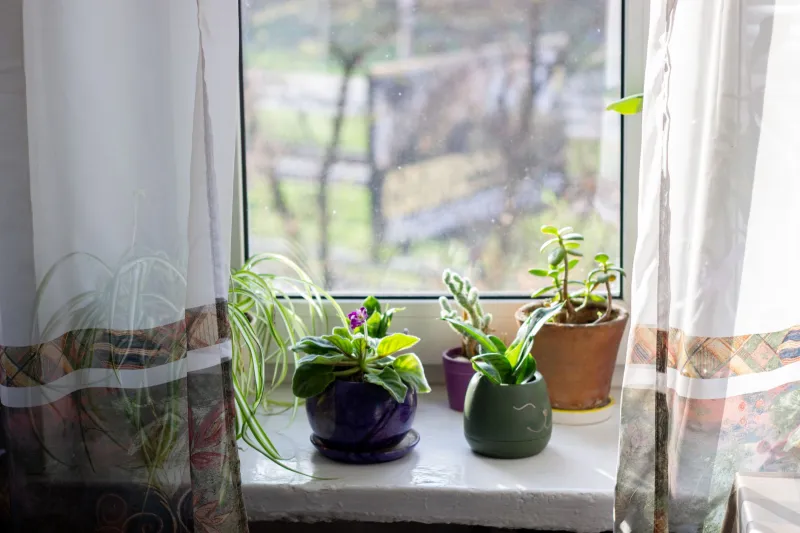
Week three: plants and dust. I'm not going to tell you a pothos will purify your air — the research on that is honestly pretty thin at real-world scale. But I added four low-maintenance plants anyway, because they make me open the blinds and pay attention to the room. The bigger move was dusting properly, including the baseboards and the top of the ceiling fan, since dust is a holding tank for everything else in the air. Vacuuming with a HEPA filter twice a week became non-negotiable.
Week four: the filter check. I checked my HVAC filter for the first time in — and I'm being vulnerable here — an embarrassing amount of time. Replaced it with a higher-MERV-rated one for about eighteen bucks. Also washed the window screens, which were gray with a film I'd been pretending wasn't there.
What Actually Changed
I kept a little journal, because self-experiments without notes are just vibes. Here's the honest rundown:
Sleep. The biggest winner. I noticed it around week two — falling asleep faster and waking up without that dry-throat, stuffy-nose feeling I'd blamed on 'allergy season' for years. Turns out allergy season was my bedroom.
Skin. Modest but real. My usual morning puffiness faded, and my skin stopped feeling tight and dehydrated by midday. I can't run a clinical trial on myself, but I wasn't the only one who noticed — my roommate asked if I'd changed moisturizers. I hadn't.
Energy. The morning window-opening ritual turned out to be as much about light and fresh air as filtration. That ten-minute reset genuinely replaced my second cup of coffee more often than I'd like to admit.
The apartment itself. Without fragrance covering everything, I noticed smells faster — which sounds bad, but it's actually useful. Now I know when the trash actually needs to go out instead of masking it with a plug-in.
The Honest Caveats
I still light candles. I still love a diffuser with actual essential oils on a Sunday. This wasn't about becoming an air purist; it was about cutting the constant, background exposure down so the occasional treat is just that — occasional.
Also worth saying: if you have serious allergies, asthma, or live somewhere with wildfire smoke or high outdoor pollution, talk to a doctor and consider a proper HEPA air purifier. My $30 budget experiment is not medical advice, just one writer's month of opening windows.
Try It Before You Buy It
If you want to steal the whole experiment, here's the shortlist: pull the plug-ins, open two windows for ten minutes each morning, check the HVAC filter, dust like you mean it, and use the fan you already own. Total cost: about twenty dollars and a little humility.
We spend so much energy curating what goes on our bodies and in them. Turns out the cheapest clean-living upgrade of my year was just clearing out what goes around them — one window, one filter, one missing plug-in at a time.